Physical Address
Crimson Lynx Media Ltd
Scottish Provident House
76-80 College Road
London
HA1 1BQ


Physical Address
Crimson Lynx Media Ltd
Scottish Provident House
76-80 College Road
London
HA1 1BQ



Mobile operators are facing scrutiny over network quality after Ofcom rclaimed train passengers experience poor mobile performance.
EE was the only network that met Ofcom’s benchmark of 42 per cent of measured rail segments. Three recorded 21 per cent, O2 reached 20 per cent, while Vodafone achieved 17 per cent.
Onboard Wi-Fi services to bridge connectivity gaps were also poor. Ttrain Wi-Fi met Ofcom’s performance threshold just one per cent of the time. The poor performance is largely due to outdated technology and speed restrictions.

Ofcom said there is inadequate signal from masts located alongside railway routes and radio signals have difficulty penetrating certain train carriage designs.
The regulator has now caledl for a coordinated industry-wide effort to improve connectivity.

The rail research was carried out by Streetwave. A separate study, covering Greater Manchester, was done by Opensignal and Streetwave
Ofcom’s study claims mobile services failed to meet a basic “good performance” standard on between 58 per cent and 83 per cent of railway segments tested, depending on the network provider.
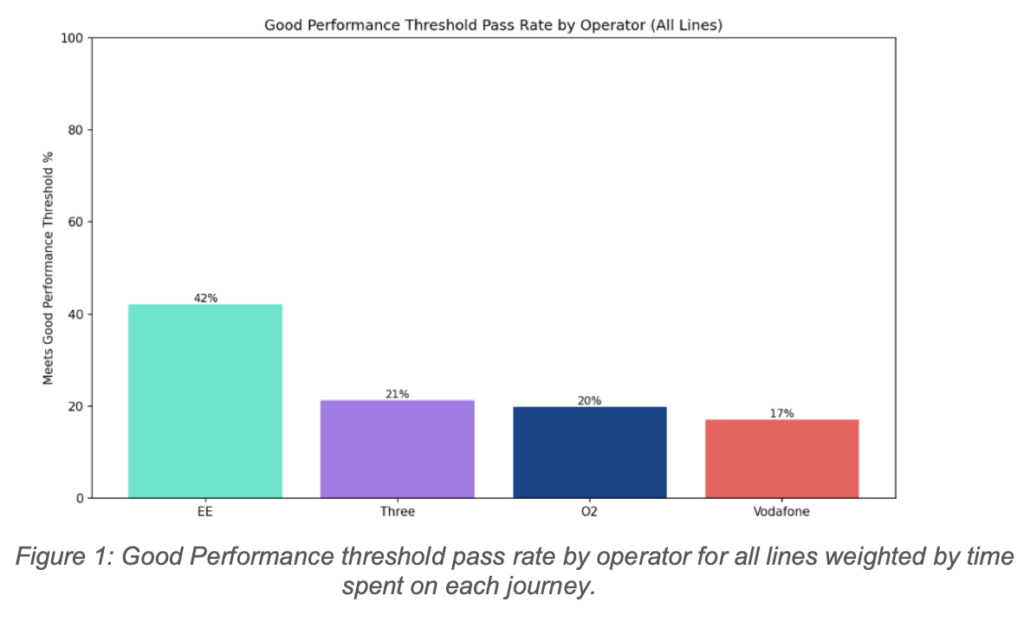
The research, conducted across 24 sections of major rail routes assessed whether networks could consistently deliver download speeds of at least 5Mbps, upload speeds of 1.5Mbps and latency below 50 milliseconds necessary for video calling and content streaming.
Mobile UK, the representative body for the UK’s mobile network operators. Said it welcomed Ofcom’s research.
“Building the advanced infrastructure requires the right enabling environment, and we urge the Government to act now through the Mobile Market Review and planning reform to establish a supportive policy and regulatory framework”, the organisation stated,
“Dedicated public investment is also critical to tackle complex trackside blackspots, as commercial rollout alone cannot bridge the gap on the rail network. We look forward to working with Government and Ofcom to achieve this, balancing the need for major investment with Ofcom’s vital role in maintaining low costs for consumer