Physical Address
Crimson Lynx Media Ltd
Scottish Provident House
76-80 College Road
London
HA1 1BQ


Physical Address
Crimson Lynx Media Ltd
Scottish Provident House
76-80 College Road
London
HA1 1BQ


Advertising Promotion
Throughput has become the defining constraint in the pre-owned phone business, and automated testing is moving from novelty to necessity. A recent integration between diagnostics software M360 and the MATT testing robot shows how far the shift now reaches.
A market growing faster than its workforce
The secondary smartphone market has quietly become one of the largest channels in consumer electronics. While new-device sales have wrestled with tariffs, macro uncertainty and lengthening replacement cycles, the pre-owned and refurbished market has kept growing – with growth strongest in emerging regions such as Africa, India and Southeast Asia. The appeal is straightforward: refurbished devices typically sell well below the price of new, and retailers are broadening their refurbished portfolios both in physical stores and online – a structural shift reinforced by OEM and carrier trade-in programmes and, particularly in Europe, by tightening circular-economy regulation.
Every one of those devices, however, has to be tested before it can be certified and sold. Cameras, buttons, screens, sensors, charging ports – each check has historically required a pair of human hands, and however capable the diagnostic software, a facility’s throughput has been capped by how many devices its operators can physically handle per shift. The response taking shape across the industry is consistent: automated diagnostic tooling is increasingly seen as the way to scale quality certification without scaling headcount, even as it raises the capital intensity of the business.
Software meets robot
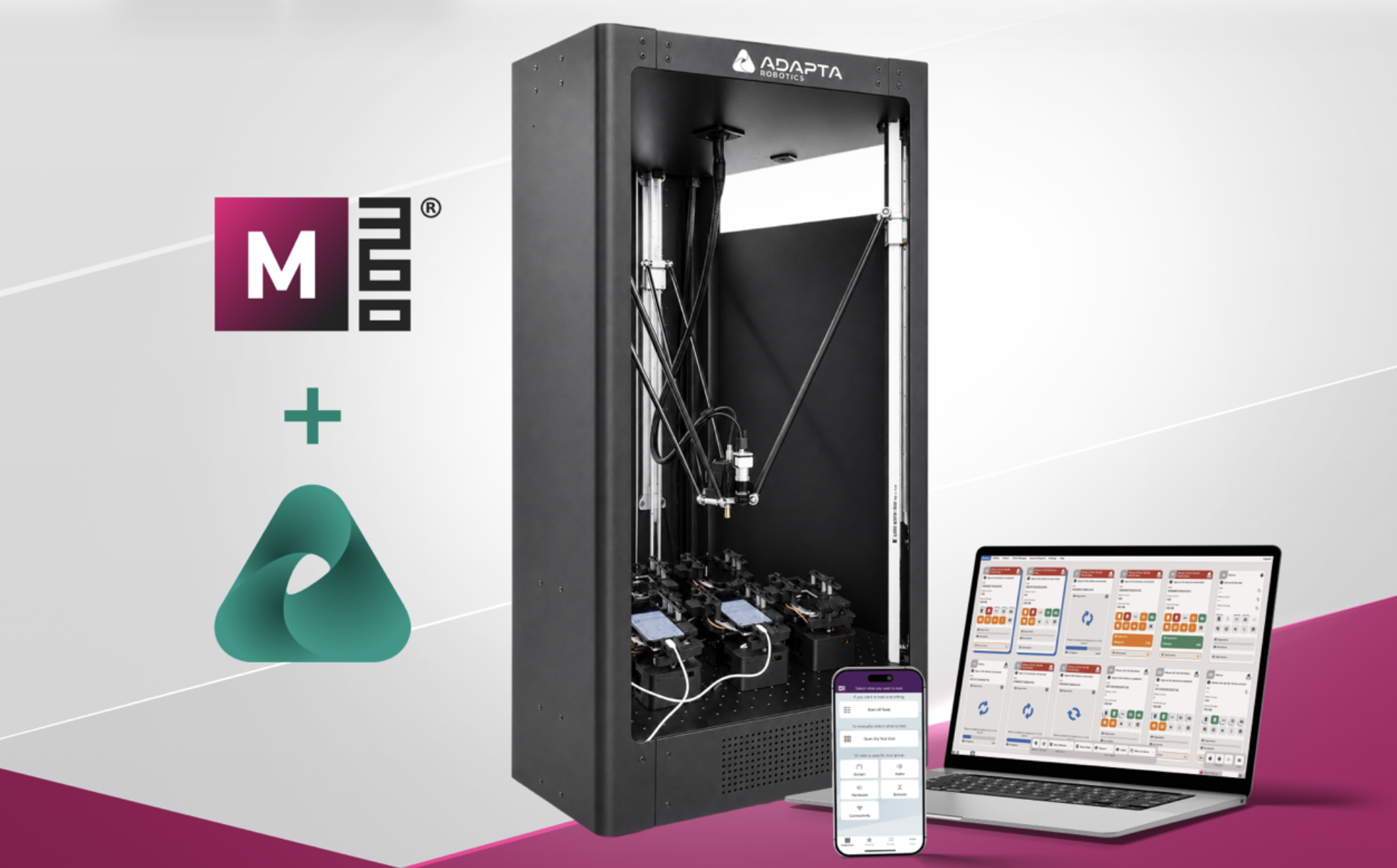
It is into this gap that M360, the diagnostic software platform for used iOS and Android devices, has moved. The independent capabilities of M360’s diagnostics and certification software and MATT by ADAPTA Robotics – a testing robot that physically operates smartphones the way a human user would, tapping touchscreens, pressing buttons and running hardware checks autonomously – are now combined to offer a complete testing ecosystem that automates both software diagnostics and physical device testing.
The headline figure is speed. Where other diagnostic software solutions typically take five to six minutes per device when paired with a testing robot like MATT, the combined M360-MATT setup cuts that time in half – directly increasing the number of devices an operator can process per shift.
MATT is not a new product. ADAPTA Robotics, a deep-tech and robotics company headquartered in Bucharest, has more than 100 of the robots deployed, with the platform in use among recommerce and consumer electronics companies. The robot is deliberately agnostic to diagnostics software, which is what made the integration possible.
“Throughout the years, at Adapta Robotics, we have been developing advanced robotic systems that automate real-world interactions with precision and consistency. MATT™ brings that capability to device testing, providing a flexible, software-agnostic platform now trusted by device refurbishers worldwide. Our partnership with M360 is a natural fit, aligned with our commitment to accelerating the industry’s transition towards automation.”
– Mihai Craciunescu, Co-Founder of Adapta Robotics
The throughput economics
For M360, the integration is an entry into robotic diagnostics rather than a change of product. Its software continues to be sold and deployed independently; on MATT, it becomes the diagnostic layer of an automated testing cell. The MATT Extended configuration handles up to five devices simultaneously, and a single operator can supervise up to nine robots at once. That multiplication of one person overseeing dozens of concurrent device tests instead of working through them one at a time is where the economics begin to matter for mid- and high-volume refurbishment operations.
“M360’s integration with MATT™ is a significant step in our expansion into robotic diagnostics. Operating together within the ecosystem, we reach a speed improvement that is a clear expression of what the solution delivers; we are now making that available to operations that are ready to run diagnostics at a higher level.”
– Péter Mártai, Product Director at M360
Certification as the currency of trust
Speed alone does not sell a used phone; trust does. Standardised grading, warranties and transparent quality certification are widely credited with moving refurbished devices from grey-market purchase to mainstream retail. Automated workflows are built around that requirement, covering the full span of hardware and software checks, from cameras, Face ID and audio through to charging ports, display condition and sensors, with each device that completes the protocol receiving a standardised, verifiable certification report recording what was tested and what passed or failed. That kind of documented, repeatable evidence is increasingly what resale channels and enterprise buyers demand.
Whether robotic testing becomes standard across the refurbishment industry will come down to throughput economics at each site. But with the pre-owned market now a durable fixture of the smartphone business rather than a fringe channel, the question facing high-volume operations is less whether to automate testing than when.