Physical Address
Crimson Lynx Media Ltd
Scottish Provident House
76-80 College Road
London
HA1 1BQ


Physical Address
Crimson Lynx Media Ltd
Scottish Provident House
76-80 College Road
London
HA1 1BQ



The UK refurbished consumer electronics market remains significantly underdeveloped despite widespread consumer awareness and growing willingness to buy pre-owned devices.
So says new research from circular economy specialist Alchemy.
The study, conducted in partnership with CCS Insight and based on a survey of more than 1,000 UK consumers, found that while refurbished technology has entered the mainstream, the industry is still struggling to convert awareness into purchases.

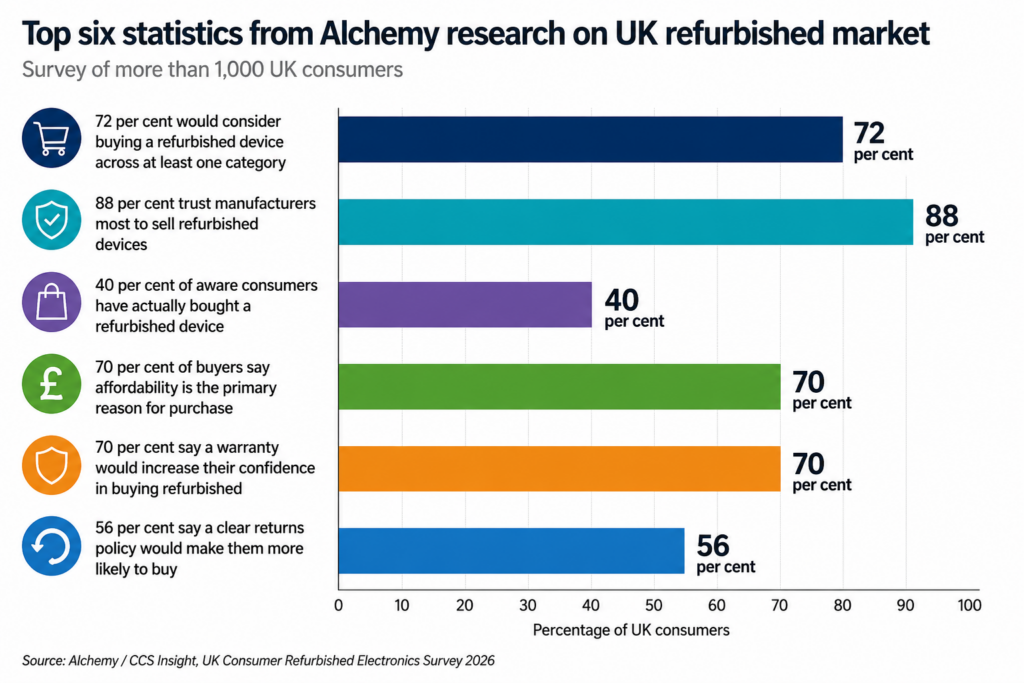
According to the research, 72 per cent of UK consumers would consider buying a refurbished device in at least one product category. Smartphones remain the most attractive refurbished product, with 41 per cent of consumers open to purchasing a refurbished handset, followed by laptops, monitors and tablets at 34 per cent . Almost a quarter (23 per cent ) would also consider refurbished home electronics.
However, despite this strong level of interest, only 40 per cent of consumers who are aware of refurbished devices have actually made a purchase.

The findings point to a significant opportunity for OEMs, retailers and mobile operators to expand sales by addressing concerns around quality, transparency and after-sales support.
Manufacturers are currently the most trusted channel for refurbished purchases, with 88 per cent of consumers expressing confidence in OEMs selling refurbished products. Retailers followed at 81 per cent , telecom operators at 75 per cent , while online marketplaces trailed significantly at 53 per cent.
Consumer adoption is strongest among younger buyers. Six in ten (60 per cent ) consumers aged between 18 and 24 have already purchased a refurbished device, while uptake declines steadily among consumers aged 45 and above, suggesting a major opportunity for targeted marketing and education campaigns.
Price remains the primary purchase driver. Seven in ten refurbished buyers cited affordability as the main reason for choosing a refurbished product, with the appeal consistent across income groups.
The research also highlights the challenge facing sellers when it comes to consumer expectations on pricing. Half of respondents said they would expect a refurbished device to be available at a 50 per cent discount compared with a new equivalent.
While pricing is important, the study suggests that trust-building measures have an even greater impact on conversion.
A warranty emerged as the single most influential factor, with 70 per cent of consumers saying it would increase their confidence in buying refurbished technology. More than half (56 per cent ) said a clear returns policy would encourage them to purchase, while 64 per cent expect at least a 30-day return period.
Battery health was another key concern, with 55 per cent of respondents saying guarantees or visible technical checks would make them more comfortable buying a refurbished device.
The research also identified grading standards as an area requiring significant improvement. Half of consumers want to see a grading report before making a purchase, while current industry terminology appears to be causing confusion.
According to the study, 97 per cent of consumers associate the term “good” with devices showing the most visible signs of wear, despite the fact that it often sits above “fair” within existing grading systems.
Alchemy argues that more consistent grading language, supported by visual examples and clearer descriptions, would make refurbished devices easier to compare and improve buyer confidence.
The study also found strong appetite for OEM-led refurbished programmes. Some 57per cent of UK consumers said they would be likely to purchase a refurbished device directly from a manufacturer if offered at a discounted price.
Reputation was identified as the biggest trust factor when buying directly from an OEM, cited by 23 per cent of respondents, followed by quality and accountability (20 per cent ), data security (14 per cent ), customer service (14 per cent ) and process transparency (11 per cent ).
Stephen Wise, Director of Global Marketing at Alchemy, said: “There isn’t a demand problem for refurbished products – consumers understand refurbished, they’re open to it and many actively want it.

“What’s holding back conversion is uncertainty about the specific device in front of them, the warranty behind it and what happens if something goes wrong. Every one of those barriers is addressable with solutions available today.
“Brands that invest in building consumer confidence don’t just win the second sale; they unlock entirely new audience groups and purchasing moments that their new range cannot reach.”
Ben Wood, Chief Analyst at CCS Insight, said the research provides a clear roadmap for the industry.
“This research gives the industry a picture of where the refurbished market stands and what it will take to grow it at scale,” he said.
“The awareness and the intent are clearly there. The key factor here is consumer confidence in quality, battery health, grading, warranty, returns and seller credibility.
“For OEMs in particular, the findings are significant. More than half of consumers are ready to buy refurbished smartphones directly from the manufacturer, and that is a commercial opportunity the industry is only just beginning to fully grasp.”

The findings come as manufacturers, operators and retailers increasingly invest in trade-in and circular economy programmes as they seek new revenue streams and look to extend device lifecycles.
The research suggests that while consumer demand exists, future growth will depend on the industry’s ability to remove uncertainty and build trust throughout the refurbished buying journey.
NB: Ben Wood will be participating in Mobile News’ secondary market conference Circular Summit on November 17 at London Hilton Bankside. Places are limited, Secure your attendance HERE