Physical Address
Crimson Lynx Media Ltd
Scottish Provident House
76-80 College Road
London
HA1 1BQ


Physical Address
Crimson Lynx Media Ltd
Scottish Provident House
76-80 College Road
London
HA1 1BQ


Apple’s expected entry into foldables tomorrow could rapidly turn the iPhone maker into its biggest player by value, according to forecasts from IDC.
Global foldable smartphone shipments fell 15 per cent year-on-year during the first half of 2026, despite manufacturers continuing to launch increasingly sophisticated devices.
Huawei currently dominates the category. It accounted for 50 per cent of foldable handsets shipped worldwide and 55 per cent of their value during the second quarter.

But IDC believes Apple’s arrival could fundamentally change the economics of the market.
It expects Apple’s first foldable iPhone to cost around $2,500 – more than twice Apple’s current average iPhone selling price of approximately $1,209.

IDC forecasts Apple could sell 10 million foldable iPhones during the first 12 months, generating around $27 billion in revenue from the new product.
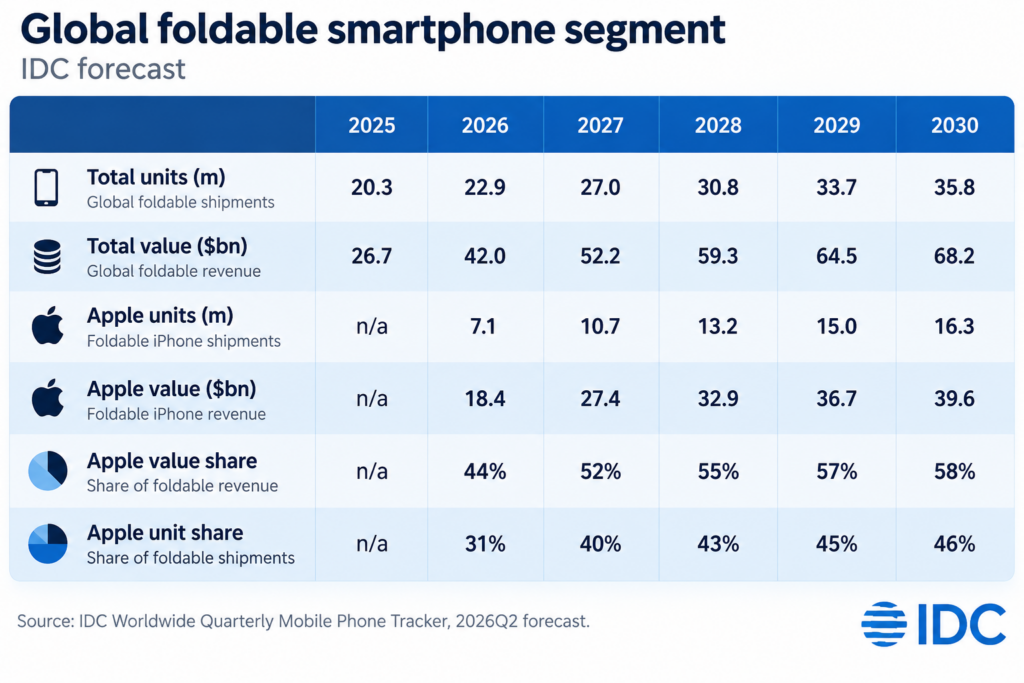
Apple is forecast to capture 31 per cent of global foldable shipments and 44 per cent of market value during 2026.
By 2027, IDC expects it to become the market leader, accounting for 40 per cent of foldable shipments and 52 per cent of their value.
Its influence could extend well beyond its own sales.
Between 2026 and 2030, IDC estimates Apple will account for around 71 per cent of the additional foldable devices sold worldwide and 81 per cent of the extra revenue generated by the category.
The overall foldable market is forecast to grow from 22.9 million devices worth $42 billion in 2026 to 35.8 million devices worth $68.2 billion in 2030.
That represents annual growth of around 12 per cent in shipments but more than 20 per cent in value.

Despite those numbers, foldables are unlikely to become mainstream smartphones anytime soon.
They are expected to account for only 2.2 per cent of worldwide smartphone shipments in 2026, increasing to 3.1 per cent by 2030.
Their importance is much greater when measured in money.
Foldables are forecast to generate 6.9 per cent of worldwide smartphone revenue this year and around 10 per cent by 2030.
For Apple, that makes a foldable less about selling huge numbers of additional iPhones and more about increasing the proportion of customers buying very expensive models.
A $2,500 device would also give Apple a substantially higher price ceiling for the iPhone range.
China could prove considerably harder for Apple.
Huawei currently controls 79.4 per cent of Chinese foldable shipments and 82.2 per cent of the market’s value.
IDC nevertheless expects Apple to gain ground quickly and potentially overtake Huawei by value around 2028.
By 2030, Apple could account for 50.8 per cent of Chinese foldable revenue, although its unit sales are forecast to remain roughly level with Huawei’s HarmonyOS foldables.
That distinction matters: Apple may become China’s biggest foldable manufacturer by revenue without necessarily selling the most devices.
Success is not guaranteed.
A $2,500 price would severely restrict the potential customer base, while Apple’s first-generation hardware will immediately be judged against rivals that have spent years improving their foldable devices.
Weight, durability and the visibility of the screen crease will therefore be closely scrutinised.
Huawei also has a five-year head start in China, together with established retail and operator relationships.
But Apple may not need to dominate foldables by volume to transform the category.
If IDC’s forecasts prove accurate, Apple’s biggest impact will be to shift foldables further towards the ultra-premium end of the smartphone market – turning a category whose shipments have recently been declining into one generating substantially more revenue from a relatively small number of devices.