Physical Address
Crimson Lynx Media Ltd
Scottish Provident House
76-80 College Road
London
HA1 1BQ


Physical Address
Crimson Lynx Media Ltd
Scottish Provident House
76-80 College Road
London
HA1 1BQ



Global smartphone will crash 12 per cent this year as soaring memory costs force manufacturers to raise prices and consumers delay upgrades, according to FDM CCS Insight.
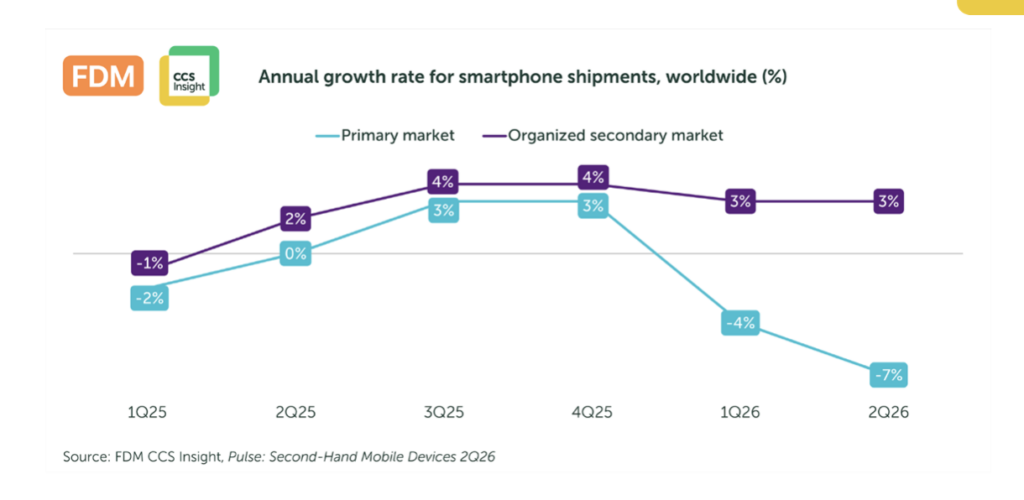
Shipments of new smartphones fell seven per cent year-on-year in the second quarter, while average selling prices jumped 13 per cent compared with the previous quarter.
FDM CCS Insight said the continuing memory shortage is pushing up component costs, with manufacturers passing increases on to consumers and shifting their ranges towards higher-priced devices.

The analyst expects memory supply constraints to continue until 2028.
“The first half of the year proved more resilient than expected,” said FDM CCS Insight analyst Ben Hatton.

“However, we remain cautious about the second half, as further price increases and prolonged memory shortages will continue to raise device prices and soften consumer demand.”
Apple was the only major smartphone manufacturer to maintain stable pricing during the first half of 2026, although FDM CCS Insight expects it to follow rivals with price increases in the coming months.
Smartphone sales in North America and Europe declined by low single-digit percentages, helped by relatively resilient demand for premium devices.
Emerging markets were hit harder as consumers in price-sensitive segments faced steeper increases and either delayed purchases or turned to refurbished devices.
 FDM CCS Insight senior analyst Ekta Mittal said the narrowing price gap between Android and iOS devices could also benefit Apple.
“Consumers are paying more for lower-specification devices than previous-generation models at similar prices,” she said.
“As affordability comes under pressure, financing, leasing and buyback programmes will be crucial for long-term adoption and to drive upgrades.”
The organised secondary smartphone market grew three per cent year-on-year during the quarter as rising new-device prices increased demand for refurbished handsets.
But shortages of used devices restricted growth and pushed up refurbished smartphone prices.
US operators have scaled back trade-in requirements attached to smartphone upgrades, reducing the volume of devices feeding into the secondary market. Strong exports from China and Japan partly compensated for the shortfall.
FDM CCS Insight expects the organised secondary smartphone market to grow nine per cent this year, although this is below its previous forecast because of continuing supply constraints.
“The opportunity for the secondary market remains immense,” said Hatton.
“As new devices become progressively more expensive, a growing number of consumers will seek alternatives in the secondary market.”
He said improving trade-in programmes would be critical to increasing the supply of used devices needed to meet growing demand.